Wednesday, February 4 | 1:00 pm EST

Webinar: ACP, UCP, and the New Agentic Commerce Landscape

Join us for a live discussion on what’s live across ACP and UCP, where merchants get stuck, and what actions make sense right now.
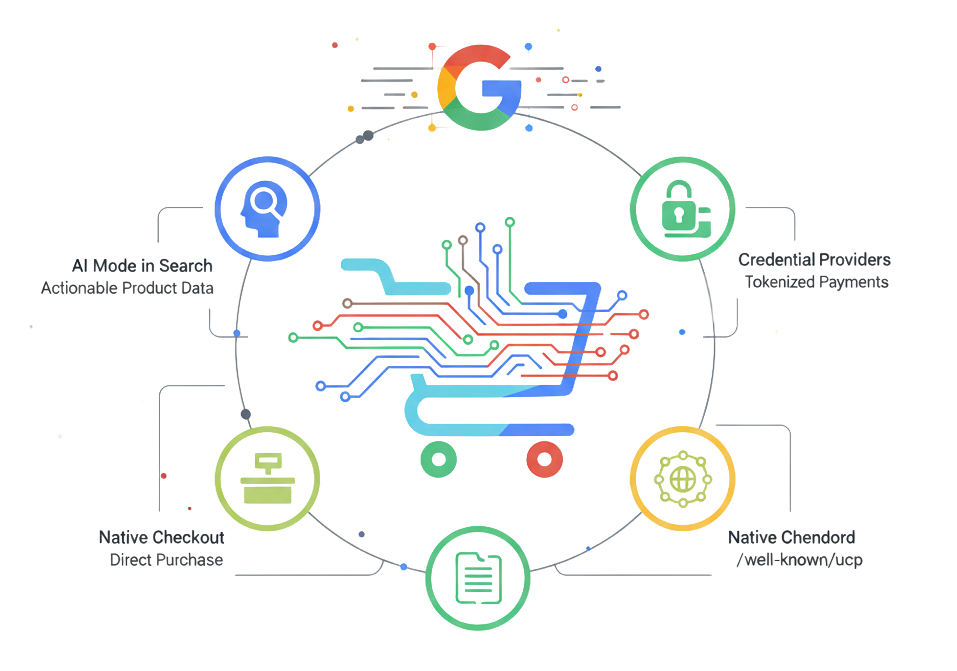

Google UCP graphic highlighting UCPs involvement in credential providers, native chendord, native checkout, and ai mode in search

How AI is rewriting discovery, checkout, and control

Agentic commerce is moving fast, and the recent announcement of Google’s Universal Commerce Protocol (UCP) adds even more momentum and questions for merchants.

In this workshop, ReFiBuy, Nekuda, and Worldpay will break down what’s actually live today across ACP, UCP, and other emerging AI checkout model, and what merchants should be doing now to prepare for 2026, even as the ecosystem continues to evolve.

What We’ll Cover 

  • What Google’s UCP announcement changes, and what it doesn’t

  • The current agentic commerce landscape (ACP, UCP, and beyond)

  • Why product feeds are becoming the real bottleneck

  • Build vs. buy decisions merchants are facing right now

  • Checkout models and their impact on margin, cart size, and retention

  • What merchants can implement today, even as protocols evolve

This session is designed for ecommerce, digital, and payments leaders who want a practical, protocol-agnostic framework for navigating AI-driven discovery, checkout, and retention, without betting on a single winner.

Watch the Recording


Meet the speakers

Harsh Mehta

Head of Partnerships, Agentic Commerce, Worldpay

Harsh has deep experience launching global business lines for tech giants like Meta, Zendesk, and Salesforce. At Worldpay, he leads the development of Agentic Commerce infrastructure, partnering with OpenAI, Google, and Visa to define the standards for autonomous AI transactions.

Idan Levin

Co-founder

CPO, Nekuda

Idan is a product strategist focused on digital commerce and user trust. As Co-Founder and CPO of Nekuda, he directs the development of the Agent Wallet SDK to enable secure, autonomous transactions for AI agents.

Reshmi Suresh

VP, Agentic Commerce, Worldpay

Reshmi specializes in AI and Agentic commerce partnerships. As head of Strategic Partnerships at Worldpay, she leads product commercialization and GTM strategy, holding an MBA from Yale and an Aerospace Engineering degree from IIT Madras.

Scot Wingo

Co-founder

CEO, ReFiBuy

Scot is a serial entrepreneur with deep eCommerce experience, founding four startups,  including ChannelAdvisor (IPO 2013) and AuctionRover.com,  while successfully exiting three.

Discover the companies

Worldpay_logo.svg

Merchant services and payment processing provider offering a payment gateway for online transactions.

LEARN MORE
logo-dark

Agentic Commerce Infrastructure for agents and merchants - enabling payments with the nekuda wallet and multi-platform agent checkout via AgentLane (ACP Gateway).

LEARN MORE
refibuy-logo-400px-01

AI-native commerce platform helping merchants optimize product data and enable instant checkout through ChatGPT and the Agentic Commerce Protocol.

LEARN MORE
FAQs

Top ACP & UCP questions from commerce leaders

The hard lift is upstream: clean, structured, machine-operable product data and checkout data that agents can reliably use. The new world requires richer attributes and more disciplined product signals, far beyond “title, price, image.”

No. Today it’s agent-led in discovery, assisted in decision-making, and human-controlled at checkout, with full autonomy still on the horizon.

The protocols can be universal, but live checkout implementations are mostly U.S.-limited today. The expectation is that it’s coming, but teams want to avoid launching a clunky or risky experience before scaling it broadly.

What is “agentic commerce,” really?

Agentic commerce is AI moving from advising to acting inside a commercial flow. Today, the most “agentic” part is usually discovery and consideration—the agent helps you search, compare, and narrow options. The transaction phase is still often human-controlled: the agent builds the cart, but a person typically hits “buy.”

What are you seeing from teams building vertical shopping agents?

Many vertical agents want to keep the entire purchase experience inside their app, not bouncing users out to a traditional merchant site. The most active category right now is fashion, because it has high research needs, higher average order values, and lots of personalization (like storing preferences or even a “closet”). Many are also combining chat + visual interfaces as a key differentiator.

How does ACP (OpenAI’s Agentic Commerce Protocol) handle payments securely?

ACP is typically described as three parts: product discovery, checkout, and delegated payments. The key security idea is delegated payments: instead of exposing card data inside an AI experience, the payment credential is handled by the PSP, which creates a short-lived, encrypted token/blob with conditions (like merchant + amount limits). That token is used to complete checkout without the AI handling raw PCI data.

How is UCP (Google’s Universal Commerce Protocol) different from ACP at checkout?

The building blocks are similar—discovery → checkout → secure payment tokenization, but Google leans on Merchant Center as a structured product layer and uses a deterministic checkout UI (to reduce hallucination risk). In early UCP flows, Google Pay is used to generate an encrypted payment payload, which merchants (or their PSP) can decrypt and process in secure environments. UCP also includes more explicit post-purchase updates (like shipping/cancellation status).

How should merchants evaluate (and differentiate between) fintech/payment partners for agentic commerce?

Ask how far your providers are in supporting the emerging specs—and whether they can keep up with how fast things are changing. Even if protocols are designed to be “stack-agnostic,” there’s still real work: APIs to connect, specs to implement, and ongoing updates as requirements evolve. A practical litmus test is simple: if a vendor can’t speak fluently about ACP/UCP and what they’ve shipped, that’s a yellow flag.

If ChatGPT/Google aren’t the merchant of record, what happens to the order and customer data?

In both ACP and UCP, the merchant remains the merchant of record and the transaction ultimately lands in the merchant’s existing commerce and order systems. The AI experience is largely orchestration, the merchant still receives the order details needed to fulfill it (and in some cases, merchants may receive more direct customer info than they would through a traditional marketplace model).