For the past year, most of the conversation about agentic commerce has centered on AI assistants surfacing products in a chat window. That shift is real, and it's the reason Agentic Commerce Optimization (ACO) exists.
But there's a second front opening, and it's closer to the buy button: Retailer-hosted agents are becoming the decision layer inside retailer-owned shopping journeys.
Amazon's Alexa for Shopping (formerly Rufus), Walmart's Sparky, and Target's Shopping Assistant are embedding AI directly into the customer journey on the platforms where purchase intent is already highest. When discovery moves inside the retailer, the questions a brand has to answer change. It's no longer just "will an assistant mention us?" It's "what product information does Alexa use, which SKUs does it surface, and why does it recommend a competitor over us?"
Those are operational questions. They have operational answers. And right now, almost no one is publishing rigorous, brand-side guidance on how to get them right.
That's the gap RetailPlaybook is built to close.
What we're launching
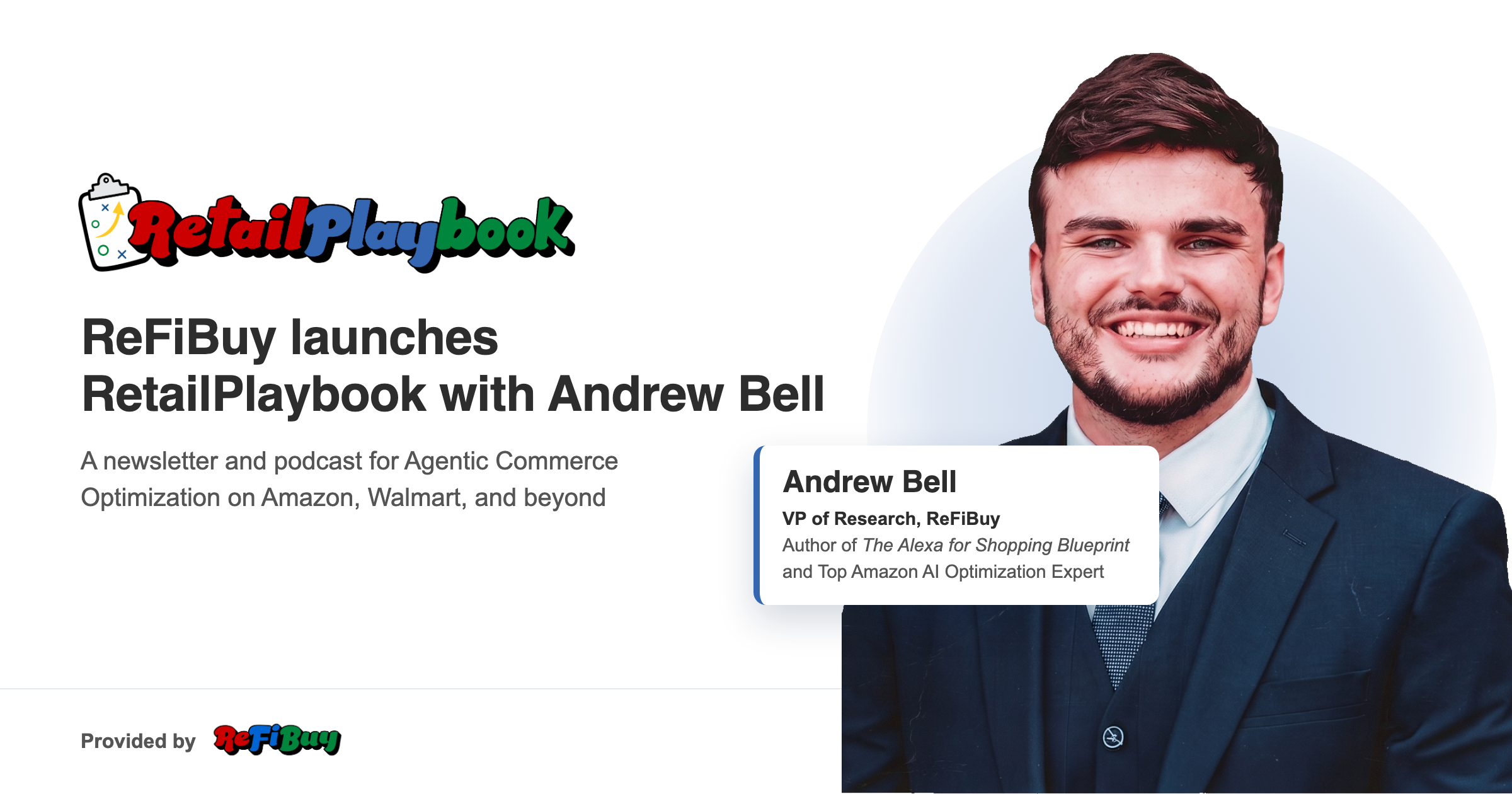
Today we're introducing RetailPlaybook, a new podcast and newsletter provided by ReFiBuy that's designed to equip brands for Agentic Commerce Optimization on Amazon, Walmart, and beyond. It launches with its first episode, Alexa for Shopping: The New Playbook for Agentic Commerce Optimization on Amazon, the opening installment in an ongoing series of original research, agent teardowns, and actionable playbooks for brand, ecommerce, retail media, marketplace, and digital shelf teams. The full press release is available here.
Leading it is Andrew Bell, who joins ReFiBuy as VP of Research and hosts the channel.
Why retailer shopping agents change the game
The numbers explain the urgency. Per Amazon, Rufus, now rebranded Alexa for Shopping, reached more than 300 million customers in 2025, with monthly active users up more than 115% and engagement rising nearly 400% year over year. Walmart has reported that customers using Sparky generate average order values roughly 35% higher than those who don't.
In other words: these aren't experiments bolted onto a search box. They're becoming a primary way products get discovered, compared, and recommended on the surfaces with the most commercial intent in retail. And the catalog signals that determine whether a product qualifies and gets surfaced are largely invisible to the teams responsible for performance.
Why Andrew Bell
We did deep research on the people doing the most serious work in this space, and all roads led to Andrew.
He's widely regarded as one of the top Amazon AI optimization experts working today as the author of The Alexa for Shopping Blueprint and one of the leading independent researchers studying how brands can optimize for AI-powered discovery on retailer platforms. His frameworks have been featured in Forbes and referenced widely across the Amazon seller and retail technology ecosystem. Andrew also writes the LinkedIn newsletter Amazon Science Made Simple and has built proprietary frameworks for how retailer agents interpret, compare, and recommend products grounded in direct Amazon operator experience.
In his words:
How RetailPlaybook fits with Retailgentic
If you already follow Retailgentic, here's the simplest way to think about the two: Retailgentic tracks how the agentic commerce market is evolving: the landscape, the platform moves, the broader shift. RetailPlaybook is the build manual: the strategies and capabilities brands need to actually compete inside that shift, with a sharp focus on retailer-hosted shopping agents.
One tells you where the market is going. The other tells you what to do about it on Monday morning.
Where this goes next
The frameworks coming out of RetailPlaybook will directly inform where we take the ReFiBuy platform. Our Commerce Intelligence Engine already operationalizes ACO across every SKU continuously evaluating, enriching, distributing, and monitoring product data so brands can improve AI readiness, visibility, and performance. Extending that work to retailer shopping agents is a natural next step, with additional product capabilities planned for release later this year.
The teams that win the agentic shelf will be the ones who built the discipline to keep their catalog interpretable as every new agent comes online. RetailPlaybook is where we'll share what that discipline looks like in practice.