Articles & Blogs
You Rated Yourself Excellent. The Agents Didn't.
A new Deloitte Digital study surveyed both sides of the counter and found a wide gap: brands believe they deliver good commerce experiences, and...
See what our product-card study reveals about product choice in AI shopping, the limits of brand visibility, and where Agentic Commerce Optimization fits.
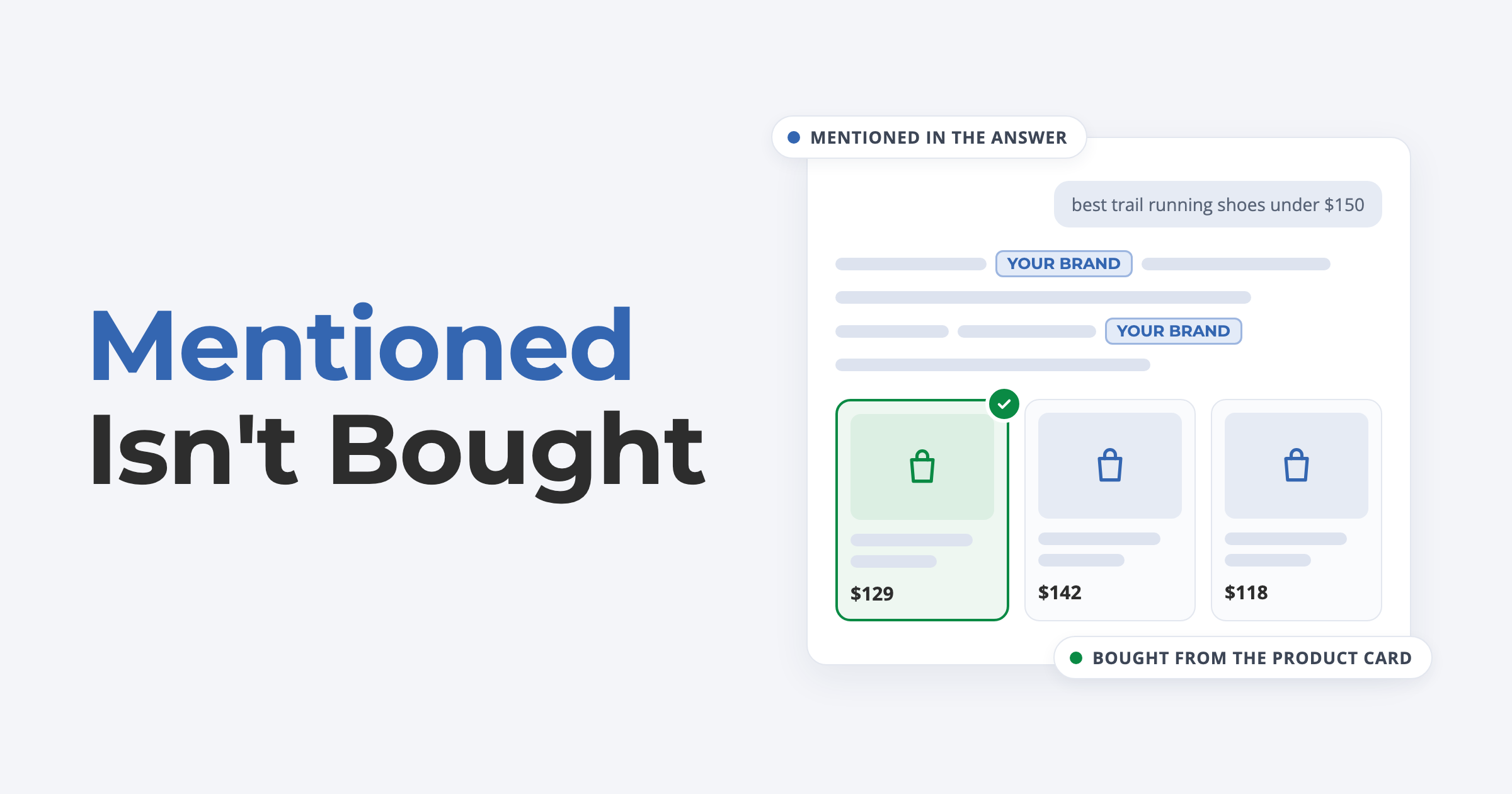
Journey Further's Brand Discovery Index, a survey of 200 senior US brand marketers published with eMarketer last month, found that 99% of respondents are confident they are visible where customers discover them, while 77% of the same group have watched high media attention fail to lift preference or demand. The report calls the distance between those two numbers a discovery confidence gap, and it is a fair description of what we hear from brands that have spent the past two years making sure answer engines know who they are: a working point of view on Answer Engine Optimization (AEO) and Generative Engine Optimization (GEO), a tool that tracks brand mentions across ChatGPT and Gemini, a dashboard that shows the mentions climbing, and no line on the revenue report that moved because of any of it.
None of that means the visibility work was wasted, and we would not tell a brand to stop doing it. The problem is that AEO and GEO improve how an answer engine talks about your brand, while the sale depends on how the AI shopping agent reads your product data, and most brands with a strong visibility program have not done that second piece of work. That work is Agentic Commerce Optimization (ACO): making sure the product data behind the recommendation gives shoppers a reason to choose you.
AEO and GEO shape the written answer, which is where a shopper does their research. The purchase decision comes later, on the product cards the AI shopping agent assembles once the shopper is ready to choose, and those product cards are built from product data: identifiers, attributes, price, availability, and imagery. The brand narrative never reaches that step, because by then the agent is reading your catalog rather than reading about you, and Agentic Commerce Optimization is the work of making that catalog something an agent can read, trust, and put in front of a shopper.
This is where the money sits. McKinsey projects up to $1 trillion in US B2C retail revenue orchestrated through agentic commerce by 2030 and says in the same report that "product directories will need to be optimized for agent readability," and Morgan Stanley's consumer tracking found that 36% of ChatGPT users had made a purchase in the past month based on an AI recommendation. Each of those purchases went to a product the agent could identify, represent, and offer, which is a function of product data rather than of how often the brand was named in the answer above it.
A brand can therefore hold strong AEO and GEO results, appear in every relevant answer, and still be missing from the product card set, or present with the wrong variant, a stale price, or no usable image, and the visibility dashboard will count all of it as a win because the brand was mentioned. The shopper buys from the product card set the agent presents, and in our shopper study the first product card shown was chosen most often, 43.4% of the time.
This summer we commissioned a study with Clickstream Solutions to record 40 US shoppers working through 224 tasks in ChatGPT and Google AI Mode, with every hover, click, and choice coded. The sessions show the handoff described above in detail.
Product cards carried 85.3% of final product choices, and a product card was the first thing shoppers engaged with in 75% of tasks, compared with 21% for the written answer. What they chose on was product data: specs, price, and brand accounted for 82.1% of the primary reasons shoppers trusted their pick, and two of those three live on the product card itself. The first-position pull we saw on product cards showed up again, more strongly, on offer cards: when more than one seller was listed, 75.9% of shoppers took the first offer card.
The clearest breakdowns that surfaced in this study were when a product card did not match the product data behind it, caught by the shopper at the point of deciding. Shoppers found prices shown on product cards that were higher than the seller's own page, and prices attached to the wrong package size, so a $36 comparison became a $48 purchase after they had already committed. The underlying problem could have been in the feed, on the product page, or in the engine's processing, and the shopper did not care which. In each case, the brand had earned the recommendation, but conflicting product details put the sale at risk.
There is a second kind of failure that sits behind the visibility numbers rather than in front of the shopper. In 36.2% of tasks where product cards were present, shoppers hovered over them, clicked none, and still reached a decision. No click means no referral, so the brand's analytics show nothing for a shopper who compared its product card against the others and chose, or walked away. That is one reason a brand can show strong visibility and flat revenue in the same quarter.
The study measured selections rather than completed purchases. But the pattern is consistent: the decision is made on data the agent pulled from your catalog, at a step that visibility tooling does not measure.
ACO is the discipline of preparing product data so AI shopping agents can interpret it, include it, and recommend it, and it sits downstream of SEO, AEO, and GEO rather than in place of them. Those disciplines get a brand into the answer; ACO gets the product onto the product card, in a strong position, with the right price and variant attached, and onto the offer card with the right seller.
An agent builds a product card from the product data it can verify: identifier, title, category, variant attributes, price, availability, and imagery. Where any of that is missing, ambiguous, or inconsistent between the feed and the product page, the agent leaves the product out, shows the wrong version of it, or shows a price the landing page then contradicts, and none of that registers in a visibility report, which only records that the brand was mentioned.
In practice, ACO means structuring and enriching your product data so that your products and variants appear as product cards for the requests that matter, and show the right item when they do. A product with no product card is not in the comparison, no matter how often the brand is mentioned. It means making specs, fit, and compatibility explicit and consistent, and keeping price, size, and variant in agreement between the product card and the destination page, rechecked as the data and the engines change. And it means treating the offer card as its own job, with its own inputs: seller, price, availability, fulfillment, and returns.
All of that is measurable in a way brand mentions are not. Product-card presence, product-card position, representation accuracy, and offer-card rank can all be observed and measured directly, and each one is a step the shopper takes on the way to purchase. ReFiBuy runs ACO as a closed-loop process at the SKU level: ingest the catalog, evaluate it against what agents need, enrich it, distribute it to the shopping engines, sync the improved data into your system of record so you own it, and monitor how each engine represents it so the next fix builds on the last.
If your AEO and GEO programs are working, keep them working. Being in the answer is the price of admission, and the brands that have earned it are ahead of most of the market.
What that work cannot do on its own is turn a mention into a sale, because the sale is decided on product cards and offer cards that the agent builds from your product data. If the mentions are climbing and the revenue is not, that is where to look: whether your products are reaching the product card, whether each product card shows the right item at the right price, and whether the shopper who chose you was handed to a seller you wanted.
Solving for that is Agentic Commerce Optimization, and it is what ReFiBuy is built to do.
Find out whether your product data is ready for AI shopping. Start with a free ACO Report for one product page or Amazon listing.
Readiness score
Specific product-data gaps
Prioritized fixes
A new Deloitte Digital study surveyed both sides of the counter and found a wide gap: brands believe they deliver good commerce experiences, and...
New behavioral study shows why getting recommended in answer engines is only the start: brands and retailers need to compete for visibility and...